Most of the shifted loads we rework could have been prevented at the dock. A stable pallet, wrap that actually holds it, and a trailer loaded so nothing has room to move do more than any fix on the road. Here are the basics, from pallet to trailer.
Start with a stable pallet
- Use a sound pallet: no broken or missing deck boards.
- Put the heaviest cases on the bottom and never stack heavy cases on light ones.
- Keep cases inside the pallet edges. Overhang crushes the bottom layers and catches on everything.
- Choose the stacking pattern for the product: column stacking keeps boxes’ corners aligned for compression strength, while an interlocking (brick) pattern ties layers together for stability.
- Add corner boards to tall or heavy loads so the wrap and straps do not crush the edges.
Wrap it so the wrap holds the pallet, not just the boxes
- Start the wrap at the pallet base and make several turns there, so the load is tied to the pallet itself.
- Overlap each layer as you work up, and keep the film under tension.
- Finish with turns at the top, and use a top sheet or cap when the top layer is uneven.
Load the trailer so nothing can move
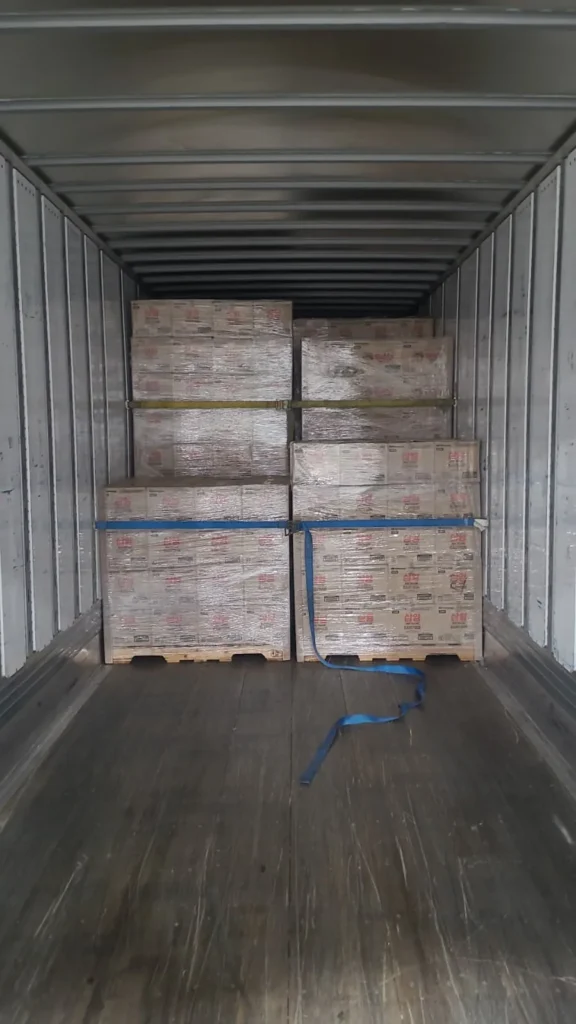
- Load tight, front to back, and avoid gaps between pallets.
- Fill any gaps that remain with load bars, straps or dunnage so pallets cannot slide.
- Spread the weight across the axles and keep heavy pallets off light ones.
- Do not double-stack pallets that cannot carry the weight above them.
Reefer loads
Follow the trailer and refrigeration manufacturer’s loading guidance and keep the airflow channels clear. Cold, damp conditions also weaken cardboard over a long run, so pallet quality and good wrapping matter even more.
Flatbed loads
Flatbed cargo is held by tiedowns, and the federal cargo securement rules apply. Under FMCSA rules (49 CFR 393.106(d)), the combined working load limit of the tiedowns must be at least one-half of the cargo’s weight, and the minimum number of tiedowns depends on the length and weight of each article (49 CFR 393.110). Use edge protection where straps cross corners.
Check the load again after the first miles
FMCSA rules (49 CFR 392.9(b)) require drivers to check the cargo and its securement within the first 50 miles of a trip and adjust it if needed, then again at each change of duty status, or after 3 hours of driving or 150 miles, whichever comes first. A load that has settled is far easier to fix in a parking lot than at the receiver. Sealed loads that the driver has been told not to open are an exception.
This is a plain-language summary, not legal advice. Check the current FMCSA rules for your load.
When prevention is not enough
If a load still arrives shifted, it can usually be rebuilt and re-secured without a warehouse detour. See Pallet Rework and Restack or find your area, or call dispatch at (840) 217-1924, 24/7.
Quick answers
What is the 50 percent rule for cargo securement?
For cargo held by tiedowns, the combined working load limit of the tiedowns must be at least half the weight of the cargo (49 CFR 393.106(d)). Other requirements, such as the minimum number of tiedowns, also apply.
Why do pallets lean in transit?
Usually a mix of an unstable build, wrap that is not anchored to the pallet, and room to move in the trailer. Braking and turns do the rest.
Should cases be column stacked or interlocked?
Column stacking gives the most compression strength; interlocking gives more stability. Many loads use the pattern the product’s packaging is designed for, plus good wrapping.