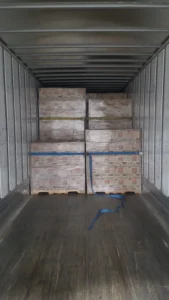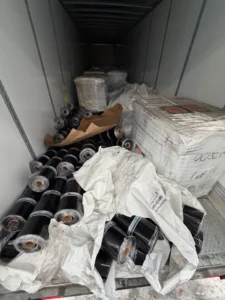
The trailer doors open and the tail pallets are leaning hard against them. One pallet’s bottom deck board has split, and the receiver’s appointment is this afternoon.
Pallet restacking is the work of taking down freight that shifted, leaned or collapsed and rebuilding it to spec on a sound pallet, then rewrapping and securing it for the road. A load needs it when a stack is out of square, cases hang over the edge, the pallet is broken, or the receiver won’t accept it as is. The record you keep matters just as much, because photos and notes taken before anything moves often decide who pays for the damage later.
Key Takeaways
- Pallet restacking means down-stacking shifted freight and rebuilding it square, stable and secured on a sound pallet.
- Rebuild when stacks lean, overhang, crush, sit on broken pallets or throw axle weights out of balance.
- A good restack anchors the wrap to the pallet base, puts heavy cases on the bottom and fills trailer gaps.
- Photograph the seal, the load and the paperwork before anything moves, then again after the rebuild.
- Agree on who authorizes and pays for the work before the crew starts.
What Pallet Restacking Means and How It Differs From Rework
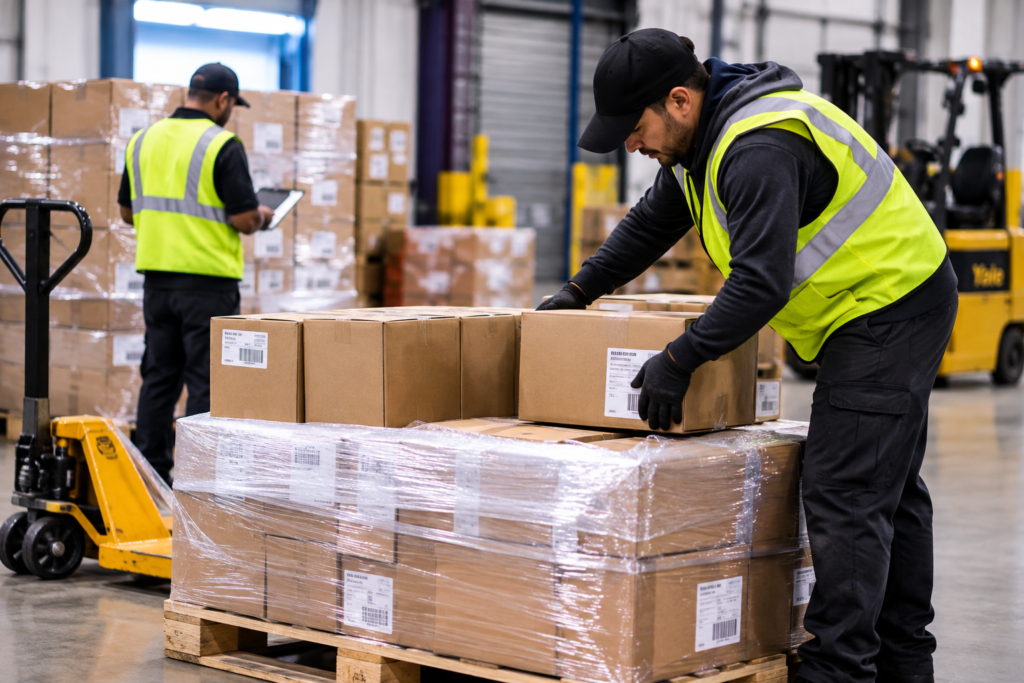
Pallet restacking is rebuilding a pallet whose cases shifted, leaned or fell, so the stack is square, stable and inside the pallet edges. It is one part of pallet rework, which can also include swapping broken pallets, rewrapping, re-securing the trailer, rebalancing axle weight or moving freight to another trailer.
Mixing up these terms on the phone can mean the wrong crew or the wrong quote.
Service | What happens | Typical trigger |
Pallet restacking | Cases taken down and rebuilt on the same pallet | Leaning or toppled stack on a sound pallet |
Re-palletizing | Freight moved from a damaged pallet to a sound one | Broken deck boards or stringers |
Pallet rework | Restacking plus rewrapping, re-securing and weight rebalancing as needed | Shifted load, receiver refusal, overweight axle |
Transloading | Freight moved from one trailer or container to another | Damaged trailer, equipment change, damage too heavy to fix in place |
If you are unsure, describe what you see and let the crew match the fix to the load.
When a Load Needs Rebuilding
A load needs rebuilding when a pallet can no longer travel or be unloaded safely as it sits. Common signs are stacks leaning past the pallet edge, crushed bottom layers, broken pallets, loose or torn wrap, freight resting against the doors, and axle weights pushed out of balance.
Not every scuffed corner needs a rebuild. Ask whether the pallet will survive the next hard brake and forklift lift.
What you see | What it usually means | Likely fix |
Stack leaning, cases intact | Wrap not anchored to the pallet, or gaps in the trailer | Restack, rewrap, fill gaps |
Cases hanging over the pallet edge | Overhang that crushes and catches | Rebuild inside the edges |
Bottom layer crushed | Too much weight above, or weak cartons | Rebuild with damaged cases set aside |
Split deck board or stringer | Pallet can’t carry the load or a forklift lift | Re-palletize onto a sound pallet |
Freight resting on the doors | Load moved rearward in transit | Open doors carefully, then restack the tail |
One axle reads heavy at the scale | Weight placed unevenly in the trailer | Move pallets to rebalance the axles |
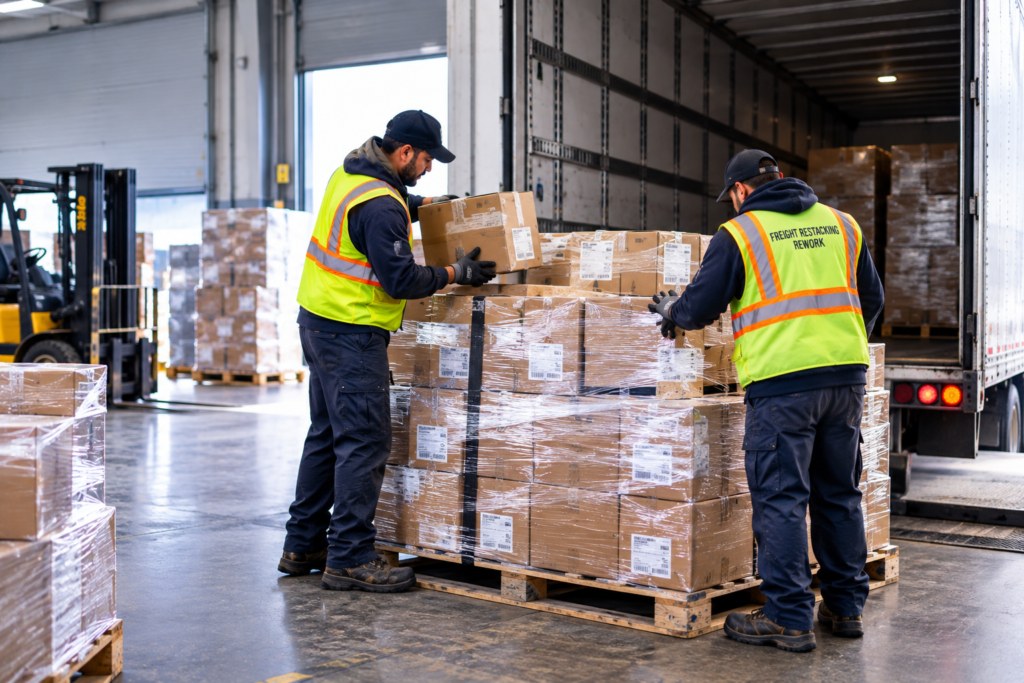
Many leaning stacks can be rebuilt inside the trailer with hand work and a pallet jack. Broken pallets, heavy freight or a damaged trailer floor usually make a dock the safer choice, and a relief trailer makes sense when the original equipment can’t carry the load safely.
Hypothetical example. A 53-foot dry van arrives with four tail pallets leaning, one on a split bottom board. The three with sound bases can likely be restacked in place, while the broken one needs a fresh pallet. If that swap can’t happen safely in the trailer, the tail section moves to a dock.
How Pallet Restacking Is Done, Step by Step
A proper restack follows a set order. The crew documents the load, takes down the shifted cases, checks the pallet and cartons, rebuilds the stack square with heavy cases low, anchors new wrap to the pallet base, then reloads and secures the trailer so nothing can slide.
1. Assess and photograph first
Open one door slightly and stand clear, because a leaning stack may fall outward. Then photograph the load exactly as found, before anyone touches a case.
2. Down-stack the shifted freight
Remove cases layer by layer from the top, keeping each SKU or order together. Set crushed, wet or leaking cases in a separate area so they don’t get mixed back into good stock.
3. Check the pallet and cartons
Look for split deck boards, cracked stringers and protruding nails. A damaged pallet gets replaced, since restacking onto a weak base only repeats the failure.
4. Rebuild the stack square
Place the heaviest cases on the bottom and keep every case inside the pallet edges. Follow the stacking pattern the packaging was designed for, whether column stacking for compression strength or an interlocked pattern for stability. Keep labels facing out so the receiver can read or scan them.
5. Wrap and reinforce
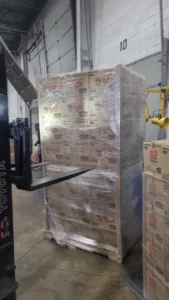
Start the stretch wrap with several turns around the pallet base so the load is tied to the pallet, not just to itself. Overlap each pass on the way up, and add corner boards or banding to tall or heavy stacks.
6. Reload, secure and check the weight
Load pallets tight and fill any remaining gaps with load bars, straps or dunnage. Federal rules require cargo to be firmly immobilized or secured using structures of adequate strength, dunnage, dunnage bags, shoring bars, tiedowns or a combination of these. Securement systems must withstand 0.8 g of forward deceleration and 0.5 g rearward and sideways, which is why open gaps matter so much.
Finally, check the axle weights. A restack that leaves one axle over its limit has not solved the problem.
What to Document Before, During and After a Restack
Document the load as found, the work performed and the load as released. That means photos of the seal, every damaged pallet and the paperwork before work starts, a count of damaged cases, notes on replaced materials, after photos and a signed condition report before the trailer leaves.
Good records show every party what arrived, what changed and who approved it.
Stage | What to record | Why it matters |
Before | Seal number and condition, wide shot from the doors, close-ups of each damaged pallet, pallet labels, bill of lading | Shows the load’s condition on arrival |
Before | Who authorized the work, and whether the receiver will accept a rebuilt load | Prevents disputes over approval and cost |
During | Count of damaged, crushed or leaking cases by SKU | Gives any later claim specific figures |
During | Pallets replaced, plus wrap, corner boards, banding and securement used | Explains what was added and billed |
After | Photos of each rebuilt pallet and the secured trailer | Shows the load left in sound condition |
After | Signed condition report, new seal number if resealed, exceptions on the delivery receipt | Gives every party the same final record |
Why this paperwork matters for claims
Under federal claim rules, a valid written claim must identify the shipment, describe the nature and extent of the loss or damage, and ask for a specific amount. The carrier then has 30 days to acknowledge it and 120 days to pay, decline or make a settlement offer in writing. Dated photos and case counts make those details far easier to prove.
Who files, and by when, also depends on the contract and the bill of lading. Treat this as general information rather than legal advice, and check your own agreements.
Most restacks start at the loading dock. Using sound pallets, keeping cases inside the edges, anchoring wrap to the pallet base, loading tight and filling gaps addresses the usual causes of shifting. An early cargo check on the road catches settling freight while it is still easy to fix.
Federal rules require drivers to inspect cargo and its securement within the first 50 miles of a trip. After that, they recheck at each change of duty status or after 3 hours or 150 miles of driving, whichever comes first, unless the load is sealed and the driver has been told not to open it.
If one lane keeps producing leaning pallets, share the before photos with whoever builds those loads.
Frequently Asked Questions
How long does pallet restacking take?
It depends on how many pallets shifted, how badly cases are damaged and whether the work happens in the trailer or at a dock. One leaning pallet is a short job, while a full trailer with broken pallets takes much longer.
Who pays for pallet restacking?
That depends on the agreements between the carrier, shipper and broker, and sometimes on what caused the shift. Confirm who authorizes and pays before any work starts, and get the quote approved in writing or by message.
Can a receiver still refuse a restacked load?
Yes. The receiver decides what it accepts, so ask before the work begins. A signed condition report with before and after photos shows the receiver exactly what was fixed.
Should damaged cases go back on the pallet?
Only if the shipper or receiver approves it. Otherwise, keep damaged cases separate, count them by SKU and note them as an exception on the delivery paperwork, since mixing them back in hides the damage.
Does a restacked load still have to meet cargo securement rules?
Yes. Federal cargo securement rules cover cargo-carrying commercial motor vehicles in interstate commerce, whether the load is original or rebuilt. A restack is only finished when the trailer is secured so the freight cannot shift again.
Conclusion
Pallet restacking is more than pushing boxes back into place. A load needs rebuilding when stacks lean, overhang, crush or sit on broken pallets, and a good rebuild ends with anchored wrap, a tight trailer and balanced axles. The before, during and after record is what protects everyone later.
If a shifted load is sitting in a yard in Fontana or across the Inland Empire, Freight Restacking Rework sends its own crews to rebuild it on-site, with a photo-documented condition report on every job. Call dispatch at (840) 217-1924, any time of day.